
Pure Menthol Crystal vs Synthetic Menthol: What’s The Difference?

The increasing global demand for menthol products is evident across diverse industries, including cosmetics, pharmaceuticals, healthcare, and FMCG. Today, buyers consistently seek method crystals following a detailed analysis of their purity, quality, industrial applications, and sourcing benefits before making decisions regarding investing in bulk supplies.
Global manufacturers are marketing with a critical analysis of menthol ingredients due to their product consistency, which directly impacts formulation. Both natural and synthetic menthol products deliver identical cooling effects. However, their manufacturing process, industrial grade, aroma profiles, and market positioning differ considerably.
A clear idea about the difference between pure menthol and synthetic menthol assists industrial buyers in choosing the right materials. This decision critically follows a comprehensive analysis of pharmaceutical formulations, skincare products, healthcare applications, and oral care solutions. In our post today, we are going to highlight the details that can help you make smart investment decisions.

What Are Menthol Crystals?
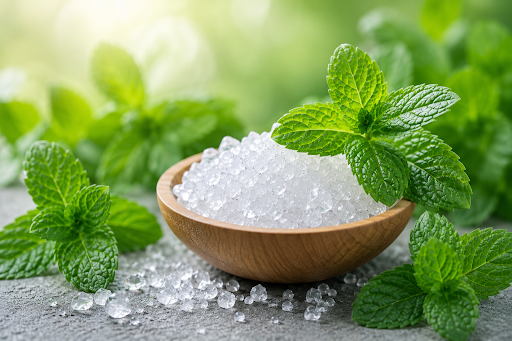
Menthol is a naturally occurring organic compound that is present in plants such as peppermint and mint. The solid menthol form is a white crystalline flake with a strong cooling sensation and a minty smell. Natural menthol crystals are primarily manufactured by menthol manufacturers in India using Mentha arvensis using two processes – steam distillation and crystallization.
Peppermint menthol crystals are high-grade, have a long shelf life, and are rich in aroma, making them widely used in various industrial applications. Natural menthol consists mainly of L-(-)-menthol, the most active form that is responsible for the cooling effect known to these human sensory receptors.
Natural Menthol crystals have the following salient features:
A herbaceous material with a mint-flavored scent
An optical purity of 90% L-menthol predominant
Excellent cooling ability with a nice mint aroma
Ideal for use in the pharmaceutical and food processing industry
Adopted industry-wide systems across regulated industry areas
What Is Synthetic Menthol?
Synthetic menthol is created in a laboratory rather than extracted from mint plants. Usually made from an assortment of chemicals that are made from petrochemical or terpene raw materials or from other natural sources.
There are several synthetic analogs with a natural menthol structure and others with a mixture of enantiomers (L-menthol and D-menthol). D-menthol has less intense cooling effects and a less pleasant smell than natural menthol.
Main properties of synthetic menthol:
Synthesized industrially using chemical processes
In large-scale applications, production costs are reduced
The intensity of cooling depends on the method of manufacture
Commonly used in commercial and industrial products
Lack of acceptance for natural labeling in some markets
Natural vs Synthetic Menthol Crystals: A Direct Comparison
Evaluation of purity, aroma quality, cooling power, regulatory acceptance, and industrial suitability is necessary for understanding natural vs synthetic menthol crystals.
Source and Production
Natural menthol is derived from the growing of mints and the extraction process used. Synthetic Menthol is produced by chemically synthesizing menthol in a laboratory, using industrial feedstocks.
Purity and Composition
The biologically active component, L-menthol, is directly responsible for the cooling effect, which is why natural menthol is common in many perfumes. Synthetic variants can be mixtures of enantiomers that reduce cooling capacity in real-world use.
Cooling Performance
Natural menthol is more effective at activating cold receptors, thus giving menthol crystal manufacturers in India of pharmaceutical and cosmetic products a stronger, longer-lasting cooling effect.
Aroma Profile
Using natural menthol gives you a "clean" mint fragrance with a fresher scent. Some synthetic and other variations can produce subtle chemical notes in perfumes that may be an issue for people with perfume sensitivity.
Regulatory Acceptance
Natural menthol as an ingredient meets the requirements of several international regulatory schemes. The artificial ingredient declarations may be required depending on the labels used in different regions.
Industrial Preference
Natural menthol is preferred by most industries that manufacture healthcare products, food, and premium cosmetics. Synthetic menthol is generally used in the low to medium-volume manufacturing processes.

Pure Menthol Crystals Benefits for Industry
A number of industries consider the pure menthol crystals' benefits from formulation performance, regulatory issues, and consumer demand.
Superior Cooling Effect
Some of the synthetic menthol products have higher cooling effects or last longer, but they are not as cooling as Natural L-menthol.
Regulatory Compliance
Natural menthol can be used in a variety of ways to help support healthy label and botanical-ingredient marketing in pharma and food.
Growing Consumer Preference
But demand for natural ingredients and plant materials is becoming increasingly significant on the global market.
Reliable Industrial Supply
Well-established menthol crystal manufacturers in India provide high-purity menthol products with quality certificates and export documents and act as bulk menthol suppliers to industries worldwide.
How to Identify Pure Menthol Crystals
One thing that could help is knowing how to look for pure menthol crystals when ordering tincture for the procurement team or the QC.
Visual Inspection
Pure menthol crystals are white to off-white and can be shaped as needles or prisms. Avoid any yellowing, discoloring, or clumping that could indicate impurities or storage conditions.
Melting Point Test
Pure L-menthol has a melting point of 41-43 °C. The range of values is much greater than this, and the sample could be a mixture of racemic impurities or adulterated.
Optical Rotation
Natural L-menthol has a specific rotation in the range of c. -45° – c. -50° (c=10, (ethanol). If racemic synthetic menthol powder is used, little, if any, rotation will be noticed. A “lab test” is a test that a reputable supplier has the ability to offer as part of its COA.
Aroma Profile
With pure menthol crystals, a minty fragrance will immediately spring forth with great impact and depth. Menthol or synthetic menthol adulteration can result in a chemical, camphor, or musty flavor.
Solubility
Menthol crystals dissolve easily in alcohol and carrier oils, but do not dissolve as well in water. If the alcohol remains undissolved or has a residue, it is an indication of impurities.
Applications of Menthol Crystals Across Industries
The cooling effect, refreshing fragrance, and versatility of menthol crystal make it suitable for various industrial uses.
The primary industries that are utilizing menthol crystals are:
Pharmaceutical and healthcare manufacturing industries
The cosmetics and personal care product industry
The food, flavors, and confectionery sector
Aromatherapy and wellness products industry
The demand for menthol by global manufacturers is increasing for versatile industrial formulation and product development applications.

Why India Leads Global Menthol Production
The Uttar Pradesh belt, comprising the sampling villages of Sambhal, Bareilly, and Barabanki, accounts for a good share of natural menthol production. It is an agroclimatic zone ideal for cultivating Mentha arvensis, with decades of experience in distillation and processing.
In India, menthol producers are enjoying:
Convenience to the areas for supplying raw materials from the mints
Professional workforce and processing facilities are available
The product is competitively priced because manufacturing expenses have been cut
International quality standards (ISO, GMP)
Well-developed export facilities for foreign markets
If international buyers are interested in purchasing menthol crystals in bulk, they will find India the most suitable destination for price, quality, and availability.
Why Shivani Chemicals Is a Name Buyers Trust
Since 2007, Shivani Chemicals has been producing and selling high-purity Menthol crystals from Sambhal, India, to exporters, formulators, and industrial buyers worldwide.
This is how they differ:
Quality control is ensured at the batch level with an ISO-certified facility
Indian and foreign export/ supplier trusted with 60+ corporates
Support with comprehensive export documentation to international buyers
If quality and reliability are not negotiable, Shivani Chemicals is your business's partner to go with.
Conclusion
India makes some of the world's top natural menthol crystals, especially in Uttar Pradesh. By selecting a dependable and approved supplier from this part of the world, you can guarantee that the quality of your bulk needs will be consistent, and that you will always have logistics to depend on.
As one of the most reputable menthol manufacturers in India, Shivani Chemicals has been exporting high-quality menthol crystals to Indian pharmaceutical, cosmetic, food, and industrial product buyers for over 13 years. Shivani Chemicals – A Leading Source of Chemicals offering ISO Certification and a pure product in every batch. Contact us today for bulk pricing, wholesale supply, and global export inquiries.
FAQs About Choosing a Menthol Manufacturer in India
1. What is the difference between pure menthol crystals and synthetic menthol?
Pure menthol crystals are naturally extracted from mint plants, while synthetic menthol is chemically manufactured in laboratories using industrial processes.
2. Why are natural menthol crystals preferred in pharmaceuticals and cosmetics?
Natural menthol crystals provide a stronger cooling sensation, fresher mint aroma, and higher purity, making them ideal for pharmaceutical and cosmetic formulations.
3. How can you identify pure menthol crystals?
Pure menthol crystals are white, highly aromatic, dissolve easily in alcohol, and usually have a melting point between 41°C and 43°C.
4. What industries commonly use menthol crystals?
Menthol crystals are widely used in pharmaceuticals, cosmetics, oral care, food processing, aromatherapy, and wellness products.
5. Why is India a leading supplier of menthol crystals?
India offers ideal mint cultivation conditions, advanced processing facilities, competitive pricing, and reliable global export support for bulk menthol supply.
Comments